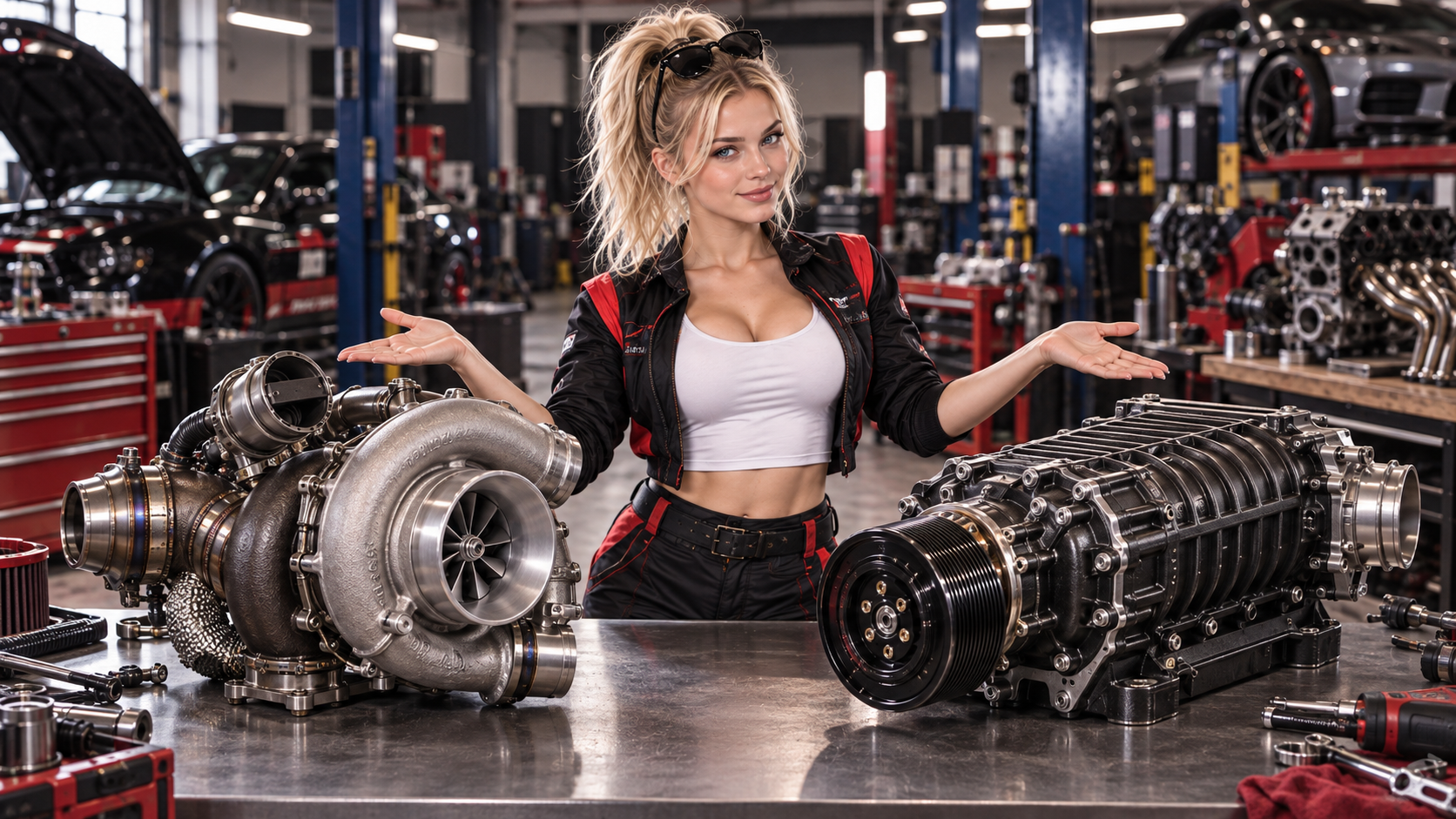
An internal-combustion engine needs air. Add more usable oxygen, add the right amount of fuel, and an engine can potentially make more power—provided its cooling, calibration and mechanical strength can handle the assignment.
A turbocharger and a supercharger solve that same airflow problem in different ways. A turbo uses exhaust-gas energy to drive a compressor. A supercharger takes mechanical power from the engine to drive its compressor. That single distinction explains much of how they feel, package and behave.
The short answer
Why compress the air?
Air pressure sets a limit on how much air a naturally aspirated engine can draw into a cylinder during its intake event. Forced induction raises the mass of air available to the engine. More oxygen can support more fuel and more combustion energy, but boost is not a magic permission slip: fueling, ignition timing, knock control, thermal management and the strength of the engine all matter.
Think of boost as a change to the engine's operating conditions, not a guaranteed power number. The compressor, engine, fuel system and calibration have to work as one system.
How a turbocharger works
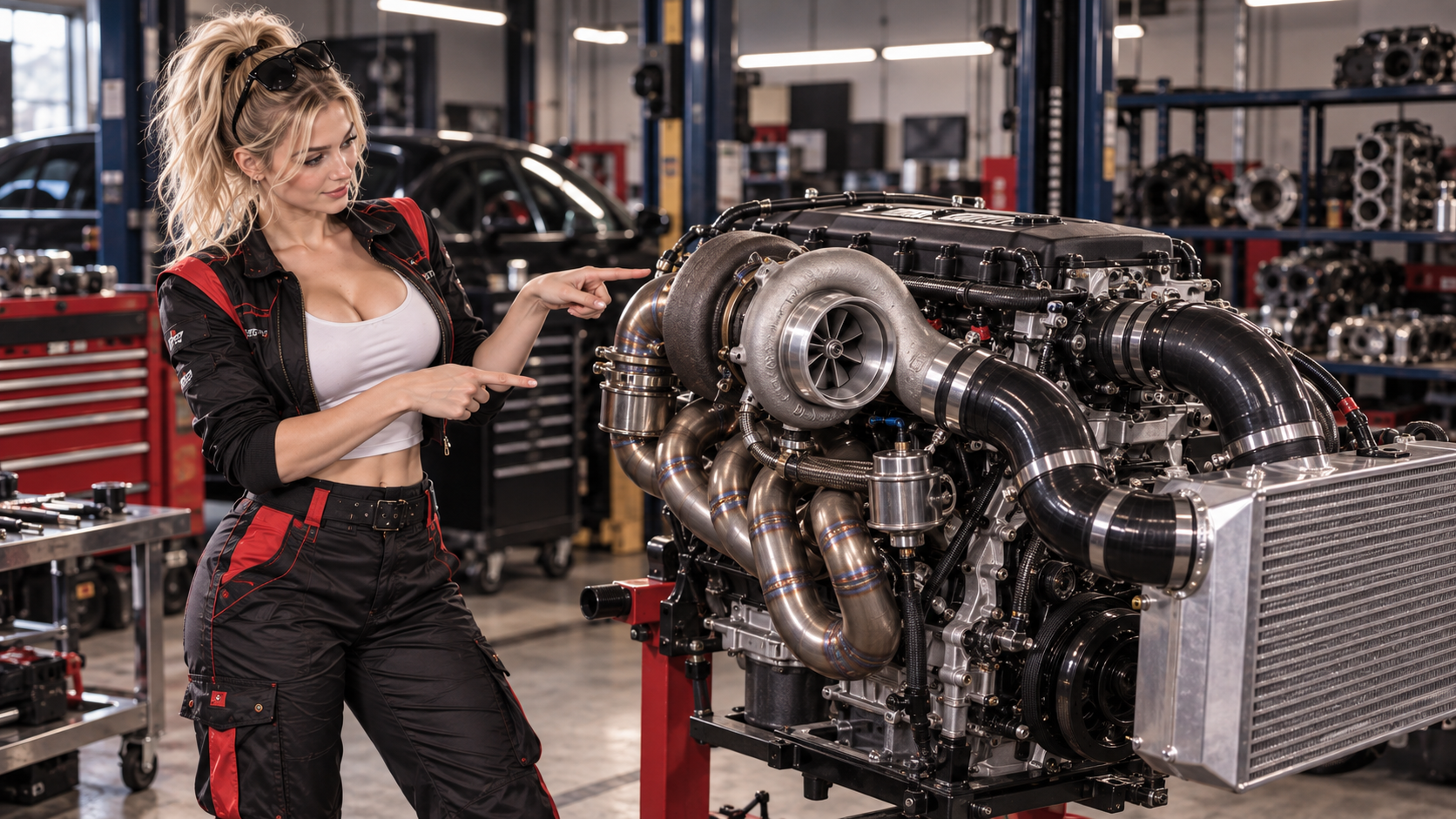
The path is easier to understand as a chain:
Hot exhaust leaves the cylinders through the exhaust manifold and enters the turbine housing. The turbine wheel extracts energy from that flow and turns a common shaft. On the other side, the compressor wheel draws in ambient air and raises its pressure and density before sending it through charge piping toward the intake.
Many systems use a charge-air cooler, or intercooler, to reduce the temperature of compressed air before it enters the engine. A wastegate can bypass some exhaust around the turbine to control turbine speed and boost. The exact plumbing and hardware depend on the application; the image is editorial and illustrative, not an exact diagram of every visible component.
What is turbo lag?
Turbo lag is not a switch where the turbo is simply off and then on. Turbine and compressor speed, exhaust flow and intake airflow all need to change as operating conditions change. The delay a driver feels depends on turbo sizing, turbine design, engine displacement, gearing, control strategy and the rest of the system.
Modern designs can improve response with lower-inertia rotating parts, twin-scroll layouts, variable geometry in suitable applications, electric assistance or carefully managed boost control. Those solutions change the trade-offs; they do not erase the underlying need to move energy through the system.
How a supercharger works
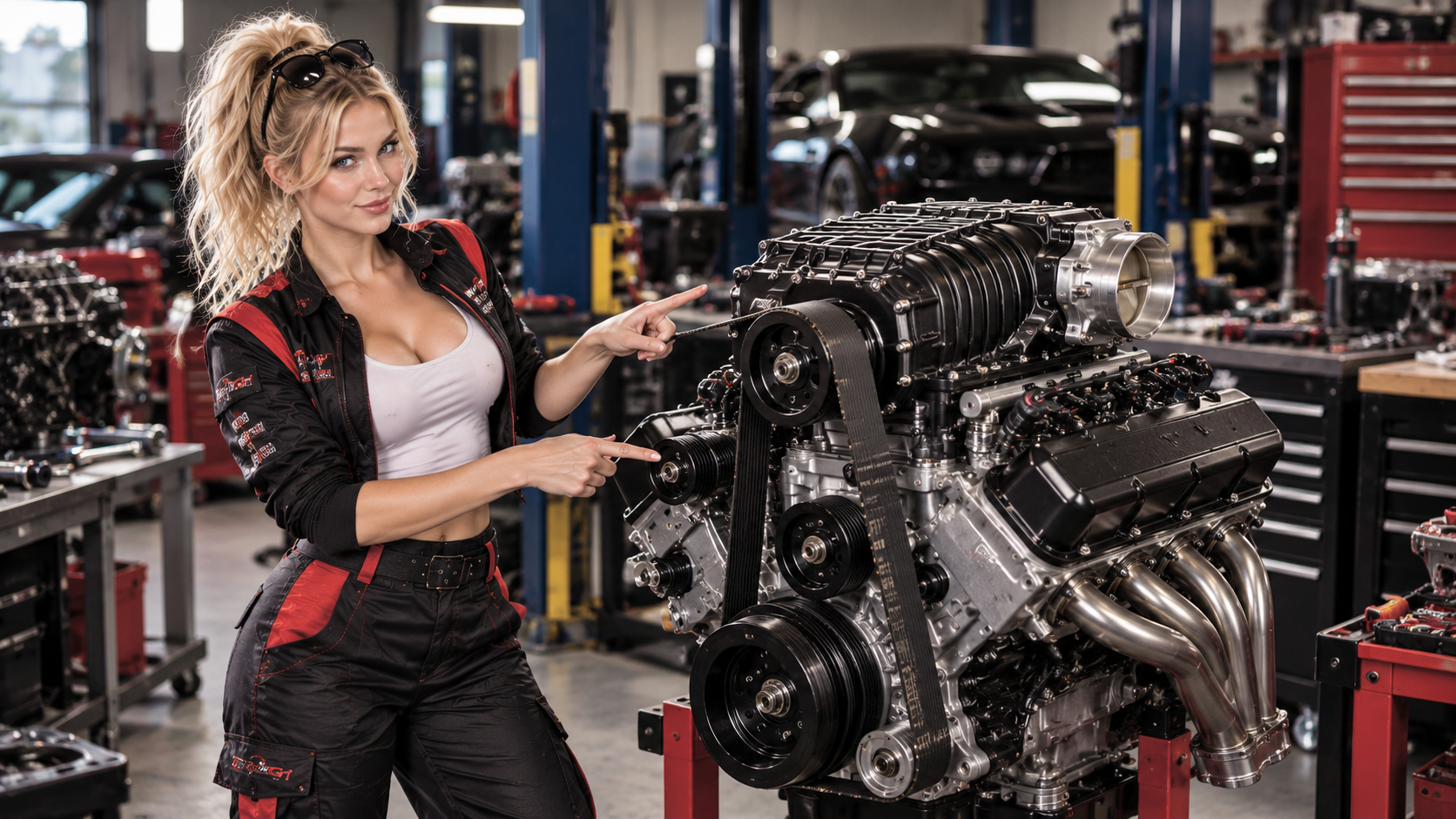
The basic path is direct:
The crankshaft drives the supercharger through a belt, gears or another mechanical arrangement. That gives the compressor a predictable relationship to engine operation, depending on the supercharger type and drive ratio. It also means the compressor receives power directly from the engine rather than waiting for exhaust flow to accelerate.
Not all superchargers are the same
Roots-type blowers move air using meshing lobes and are commonly associated with strong displacement-style airflow. Twin-screw designs use interleaving rotors to compress air internally. Centrifugal superchargers use an impeller and behave more like a belt-driven compressor, with boost characteristics that generally build with speed. These are useful tendencies, not universal promises: size, gearing, efficiency and calibration change the result.
The energy has to come from somewhere
A compressor requires power. In a turbocharged system, much of the driving energy is taken from exhaust flow that would otherwise leave through the exhaust, but the turbine also creates exhaust backpressure and changes the engine's pumping work. Turbocharging is not free energy.
In a mechanically driven supercharger, the compressor receives power directly from the engine. That parasitic mechanical load is the price of the direct drive. The trade can be worthwhile when the application values its response, packaging or power-delivery character.
Heat: the hidden problem
Compressing air raises its temperature. Hotter air is less dense than cooler air at the same pressure, and in a spark-ignition engine it can also reduce the margin against knock. That is why intercooling and thermal management are common parts of forced-induction systems.
Good cooling does not only protect components. It helps the engine receive a more consistent, denser charge and gives calibration more room to work. The radiator, charge-air cooler, ducting, oil system and engine bay all become part of the power equation.
Response and power delivery
Turbocharged systems can offer strong efficiency potential, flexible packaging and large power capability, with response shaped by the complete design. Mechanically driven superchargers can offer a direct mechanical relationship to engine speed, a distinctive power curve and simpler exhaust routing. Neither list is a guarantee; the hardware has to be matched to the engine and its job.
To separate torque from power at a given engine speed, try the Torque-Power Explorer. Supplied samples help explain a powerband; they do not predict boost response or the performance of a turbocharged or supercharged engine.
Turbocharger vs supercharger: side by side
| Question | Turbocharger | Supercharger |
|---|---|---|
| Driving energy | Exhaust-gas energy through a turbine | Mechanical power from the engine |
| Compressor drive | Common shaft shared with turbine | Belt, gears or another mechanical drive |
| Response | Depends on airflow, sizing and control strategy | Directly related to the mechanical drive and type |
| Engine load | Exhaust backpressure and pumping effects | Parasitic mechanical load |
| Exhaust involvement | Central to turbine operation and boost control | Not required to drive the compressor |
| Heat management | Compressed-air and turbine-side heat are important | Compressed-air and drive-system heat are important |
| Packaging | Needs hot-side and charge-air routing | Needs compressor space and drive alignment |
| Control complexity | Wastegate, bypass, variable geometry or electronic controls may apply | Drive ratio, bypass and throttle strategy vary by design |
| Common applications | Downsized road engines, diesel, racing and performance builds | Performance road cars, racing and applications valuing direct drive |
Which one makes more power?
There is no meaningful universal winner. Power depends on the engine, compressor size, boost pressure, airflow, fuel, cooling, calibration, mechanical strength and intended operating range. A carefully matched system can outperform a poorly matched one regardless of the badge on the compressor.
Which one is better?
That depends on the objective. A turbocharger may make sense when exhaust-energy recovery, efficiency and a particular performance target support the added hot-side and control complexity. A supercharger may make sense when direct mechanical response, a specific power curve and available drive packaging matter more.
Why engineers sometimes use both
Compound or twincharging systems combine a turbocharger and a supercharger so each can contribute in a different part of the operating range. The idea is a reminder that engineering rarely has to choose between two labels when the requirements call for a more complicated solution.
For a contrasting example of a naturally aspirated racing engine, read How a NASCAR V8 Engine Works.
Final thoughts
Both machines solve essentially the same problem: getting more air into the engine. The fascinating part is that they obtain the energy to do it in fundamentally different ways.