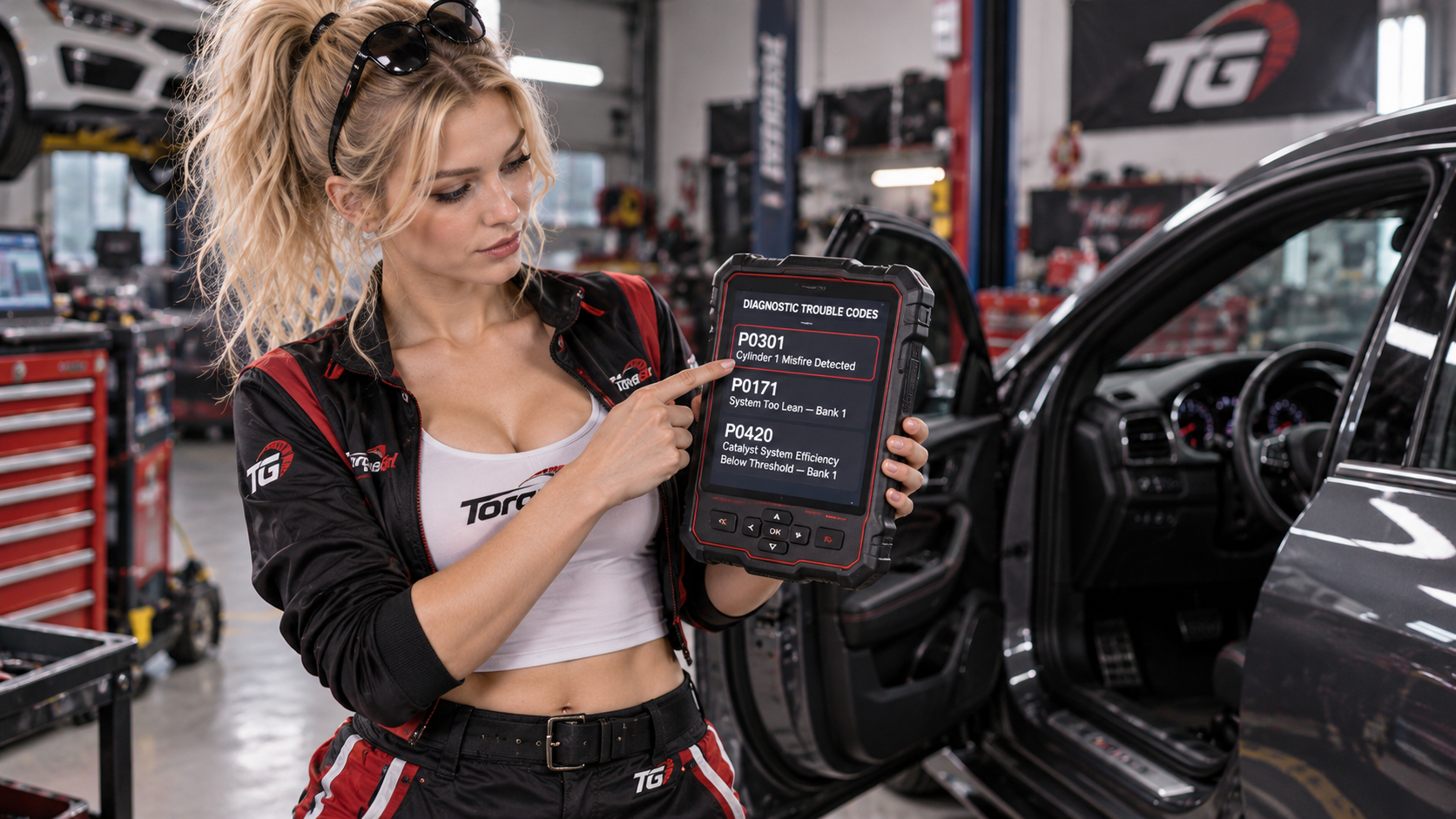
You plug in an OBD2 scanner and expect a sentence saying, “Replace this part.” Instead, the screen gives you P0301. It looks cryptic, but it has structure. Learning to read that structure tells you which diagnostic area reported the problem and where to begin looking.
The important distinction is simple: the code is the beginning of diagnosis, not the end of it. It describes what the vehicle detected. Your job is to gather evidence, test likely causes, and confirm the root problem before replacing anything.
What is a diagnostic trouble code?
DTC means Diagnostic Trouble Code. Vehicle control modules watch systems and operating conditions such as combustion, emissions, wheel speed, and communication between modules. When a monitored condition meets the vehicle's diagnostic criteria, the module may store a code. Depending on the system and fault, it may also request a warning lamp.
That last detail matters: not every stored code automatically turns on the check-engine light. The code's state, the system involved, and the vehicle's monitoring strategy all provide context.
Why does a code look like P0301?
Many OBD2 codes use a five-character format. P0301 is not a random number; its characters carry organized information. They narrow the area of the vehicle and the type of diagnostic condition, but they are not a universal promise that every character can be decoded in isolation.
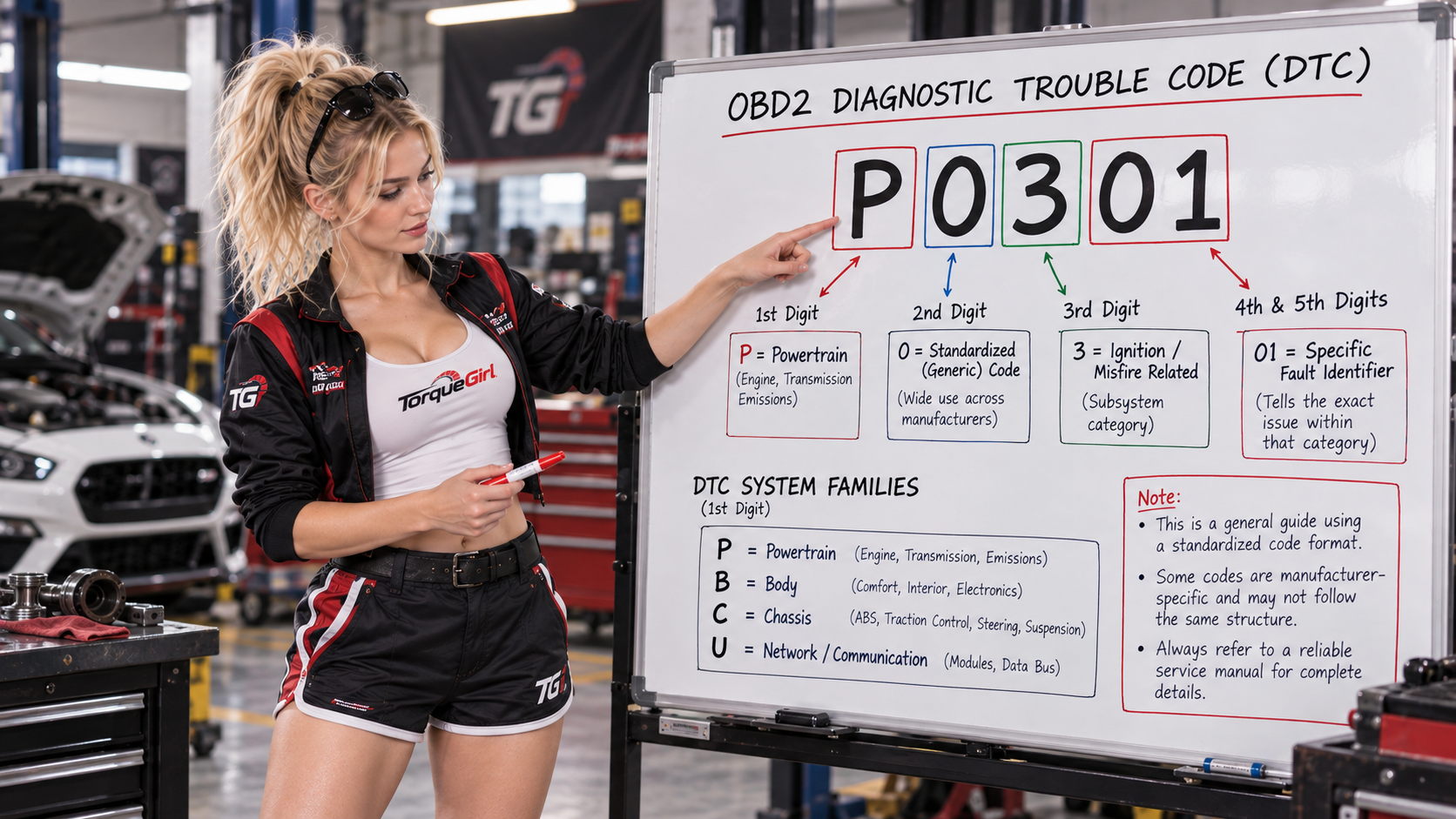
First character: P, B, C or U
The first character identifies a broad system family:
- P — Powertrain: generally engine, transmission, and emissions-related powertrain systems.
- B — Body: body systems, comfort functions, and related electronics.
- C — Chassis: systems such as braking, steering, and suspension, depending on the vehicle.
- U — Network: communication between control modules or vehicle networks.
These are useful directions, not a map to one physical component. Modern vehicles have complex module architectures and manufacturer-specific implementations.
Generic versus brand-specific codes
In common OBD2 formats, the second character helps distinguish standardized or generic areas from manufacturer-specific ones. A P0xxx code is commonly standardized, while other code families may require enhanced vehicle information.
Do not treat that pattern as a universal decoder for every system. The complete code definition, the exact vehicle, and reliable service information remain important. This is also why a more capable tool can reveal information that a basic reader cannot. For background, see OBD2 Scanner vs Code Reader.
What do the remaining digits mean?
The later characters narrow the diagnostic category and specific fault identifier. With P0301, the useful complete definition is Cylinder 1 Misfire Detected. That tells you the engine-management system detected misfire behavior associated with cylinder 1. It does not prove that spark plug 1 is bad.
Think of the code as a structured observation. It is specific enough to guide the next question, but not enough to skip testing.
Three real examples
Investigate possible ignition, injector, wiring, fuel-delivery, air/vacuum, compression, mechanical, and engine-management causes.
Consider unmetered air, intake or vacuum leaks, fuel delivery, sensor information, and exhaust or air-measurement issues depending on the system.
Consider sensor data, exhaust leaks, engine operating condition, misfire history, fuel-control problems, and catalyst condition before concluding that the converter is the failed part.
Have a recorded sensor log? Use the TorqueGirl OBD2 Log Analyzer to inspect sensor relationships and recording quality alongside your diagnostic context.
Stored, pending and permanent codes
A scanner may show different states. A stored or confirmed code means the vehicle recorded a fault that met its criteria. A pending code is an early or intermittent observation that may become confirmed if the condition repeats. A permanent emissions-related code has a different clearing behavior: it cannot simply be manually erased with a scanner and is tied to the vehicle's monitoring and verification process.
What is freeze-frame data?
When certain faults are detected, the vehicle may capture operating information around the event. Freeze-frame data can include RPM, coolant temperature, vehicle speed, engine load, and fuel-trim information. The code tells you what was detected; freeze-frame data can suggest when and under what conditions it happened.
For a foundation in scanners, ports, live data, and diagnostic limits, start with What Is an OBD2 Scanner?.
Code description versus root cause
Here is the parts-cannon mistake:
Better reasoning looks like this:
An observed symptom is not the same thing as a root cause. That difference is the heart of diagnosis.
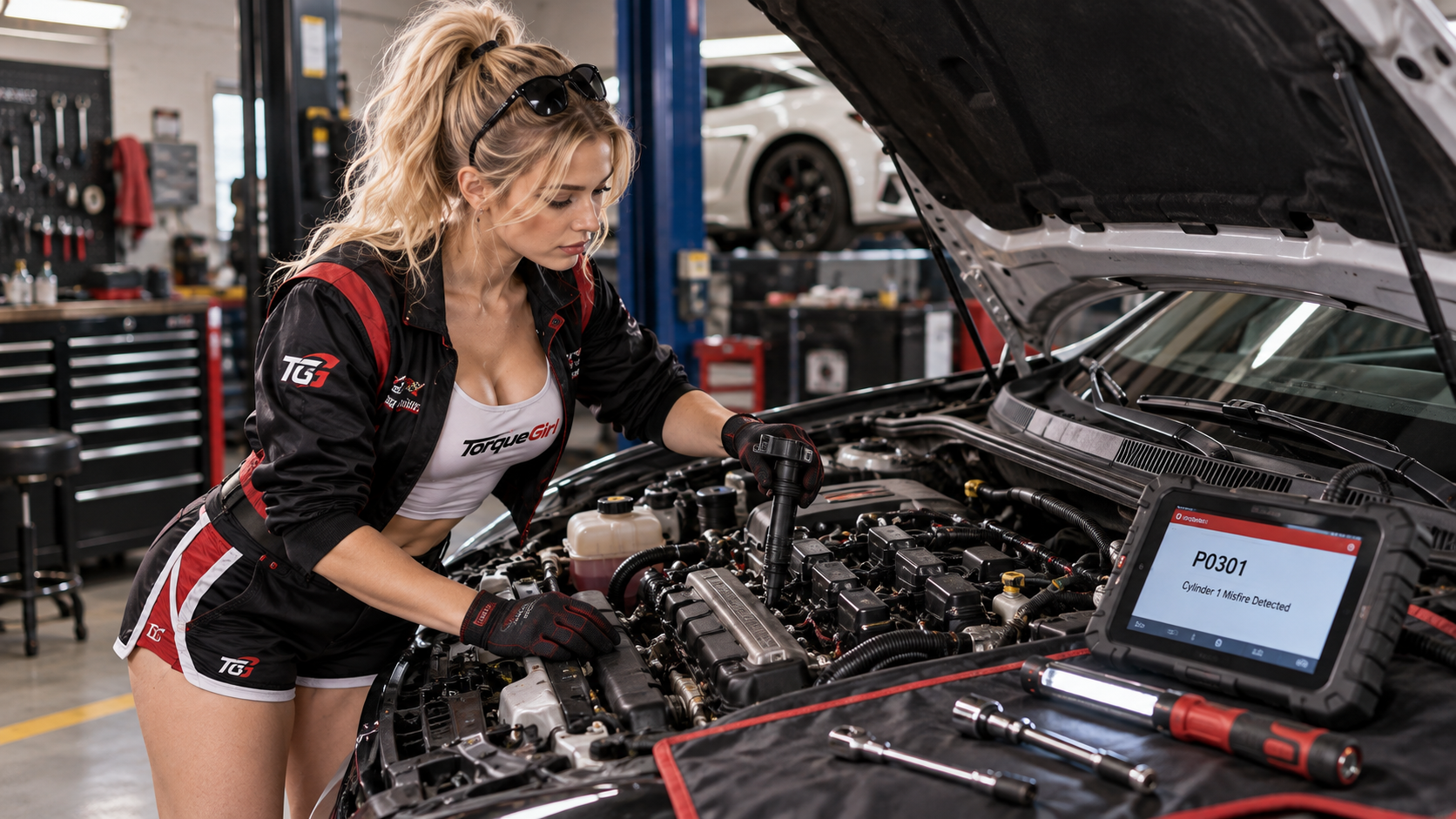
A simple P0301 diagnostic thought process
- Confirm the complete code and its current state.
- Record freeze-frame information if available.
- Note the actual symptoms and when they occur.
- Inspect obvious wiring, connectors, and related conditions with the engine off.
- Consider ignition, fuel, air, and mechanical causes.
- Use appropriate tests and data to narrow the possibilities.
- Confirm the failed condition before replacing a part.
Why clearing the code is not a repair
A scanner may clear many stored DTCs, but clearing removes diagnostic information and may reset emissions-readiness monitors. It does not repair the underlying condition. Record useful information first; if the fault remains, the monitoring system may detect it again.
Should you Google the code?
Yes—if you use the result as a starting point. Searching can clarify the basic definition, common diagnostic patterns, and where to find manufacturer service information. But the same P0301 can appear on different vehicles with different procedures and common failure modes. Code plus vehicle context matters more than a random parts-replacement list.
What should you do after reading a code?
- Write down the complete code.
- Read the complete definition.
- Save freeze-frame information if available.
- Observe the actual symptoms.
- Check relevant live data.
- Develop possible causes.
- Test before replacing parts.
OBD2 trouble code FAQ
What does the P in an OBD2 code mean?
P generally identifies a powertrain code family, covering areas such as engine, transmission, and emissions-related systems.
What is the difference between P, B, C and U codes?
P is powertrain, B is body, C is chassis, and U is network or communication. These are broad families, not automatic component diagnoses.
What does P0301 mean?
It means Cylinder 1 Misfire Detected. It does not identify which component caused the misfire.
Does P0301 mean I need a new spark plug?
No. The cause could involve ignition, fuel, air, wiring, compression, mechanical condition, or another engine-management issue.
Can an OBD2 scanner tell me exactly which part is broken?
No. It provides diagnostic evidence. Testing is still required to identify the root cause.
What is a pending code?
It is an early or intermittent observation that may become confirmed if the condition repeats.
What is a permanent code?
It is an emissions-related record with special clearing behavior tied to the vehicle's monitoring process; it cannot simply be manually erased with a scanner.
Should I clear a code after reading it?
Usually record the code, state, symptoms, and freeze-frame data first. Clearing can remove useful information and reset readiness monitors.
Can I drive with a check-engine light?
Severity depends on the fault and symptoms. A flashing light is commonly associated with a condition requiring prompt attention, such as a severe misfire. Follow the vehicle manufacturer's guidance and avoid continuing to drive with serious symptoms.
Once you have recorded the codes and freeze-frame evidence, continue with How to Analyze OBD2 Live Data and Logs. Compare the reported behavior with the conditions around your question, then plan a suitable verification instead of guessing at parts.