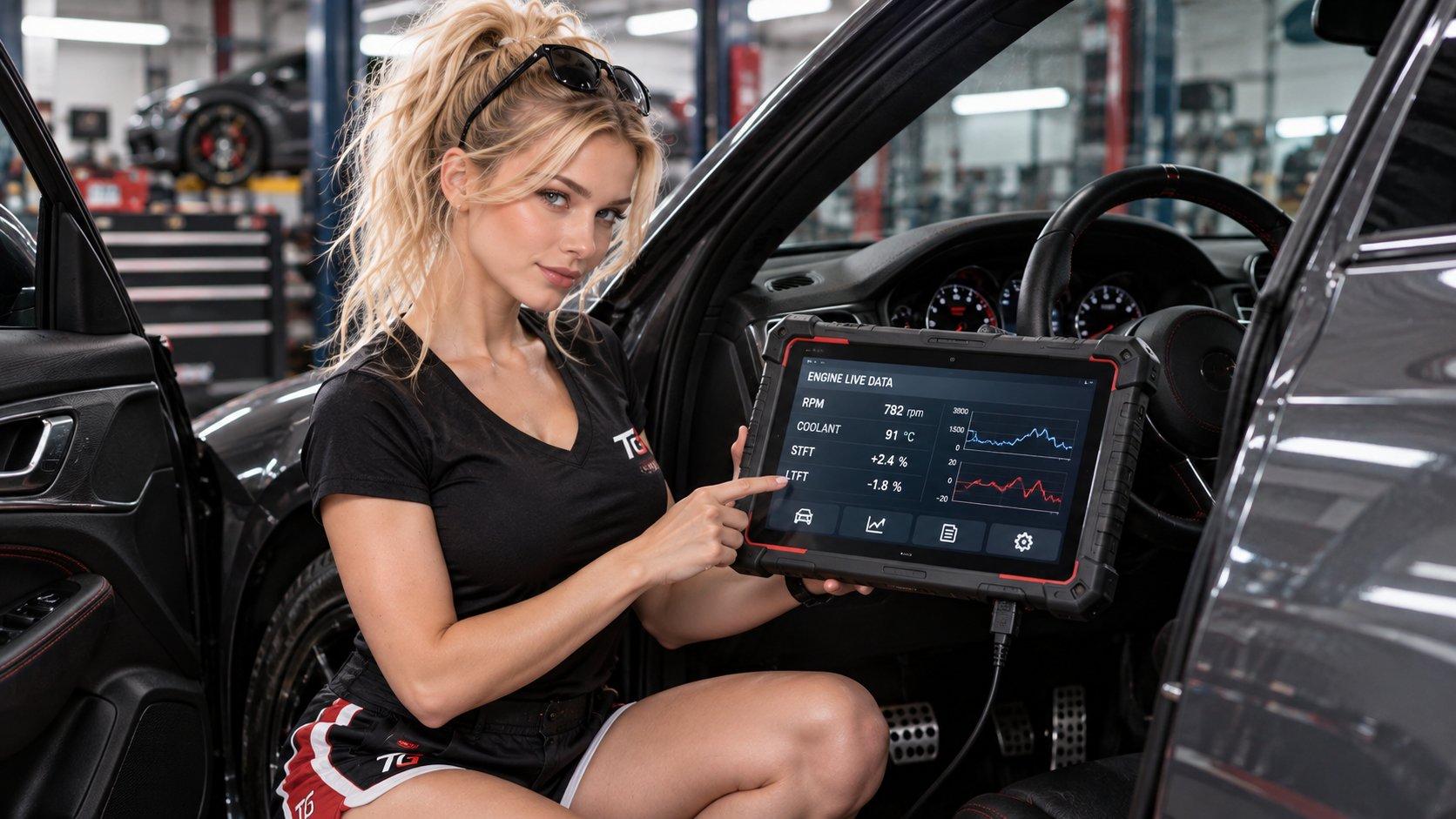
Search for an OBD2 scanner and you quickly meet two very different-looking products: a small reader that fits in one hand and a large tablet covered in menus. Both may plug into the same diagnostic port. So why can one cost dramatically more than the other?
The useful answer is not “the bigger screen is better.” It is that the tools may be able to ask different questions of the vehicle. A basic code reader tells you what the car reported. A more capable scan tool gives you more information to investigate why it happened.
If you need the fundamentals first, start with What Is an OBD2 Scanner? A Beginner's Guide to Diagnosing Your Car. This article moves to the next question: what kind of tool actually fits the diagnosis you want to perform?
Have a CSV or TSV recording? Open the TorqueGirl OBD2 Log Analyzer to review its mapping, inspect the timeline and compare operating regions locally in your browser.
First, the terminology is messy
In everyday conversation, “OBD2 scanner,” “OBD2 reader,” “code reader,” “diagnostic scanner,” and “scan tool” are often used interchangeably. Retail listings do the same. The label on the box is therefore less useful than the capability list behind it.
For this comparison, TorqueGirl will use basic code reader for a simpler tool focused mainly on generic OBD2 engine and emissions information. We’ll use advanced scan tool for a more capable device that may access additional modules, enhanced data, service functions, or bidirectional controls—depending on the exact vehicle, manufacturer coverage, and software level.
What does a basic code reader do?
A basic reader is built around a straightforward question: what did the vehicle’s generic OBD2 system report? Typical functions may include connecting through the OBD-II port, reading generic powertrain or emissions DTCs, displaying check-engine-light information, clearing codes, and checking readiness status.
Some readers also show freeze-frame information or basic live data. Not every inexpensive reader supports every one of these features, and the quality of the explanations can vary. The basic use case remains useful: a warning light appears, and the owner wants an initial report before deciding what to do next.
What does an advanced scan tool add?
An advanced scan tool may communicate with more of the vehicle’s electronic systems. Depending on the tool and vehicle, that can include enhanced manufacturer-specific codes, ABS, SRS or airbag modules, transmission data, body-control modules, richer live-data views, graphs, service functions, actuator tests, and bidirectional controls.
“May” is doing important work in that sentence. A large tablet does not automatically unlock every module on every car. Coverage depends on the vehicle, protocol, manufacturer data, subscription or update level, and the tool’s own design. Always check the exact vehicle coverage rather than trusting a broad phrase such as “full system.”
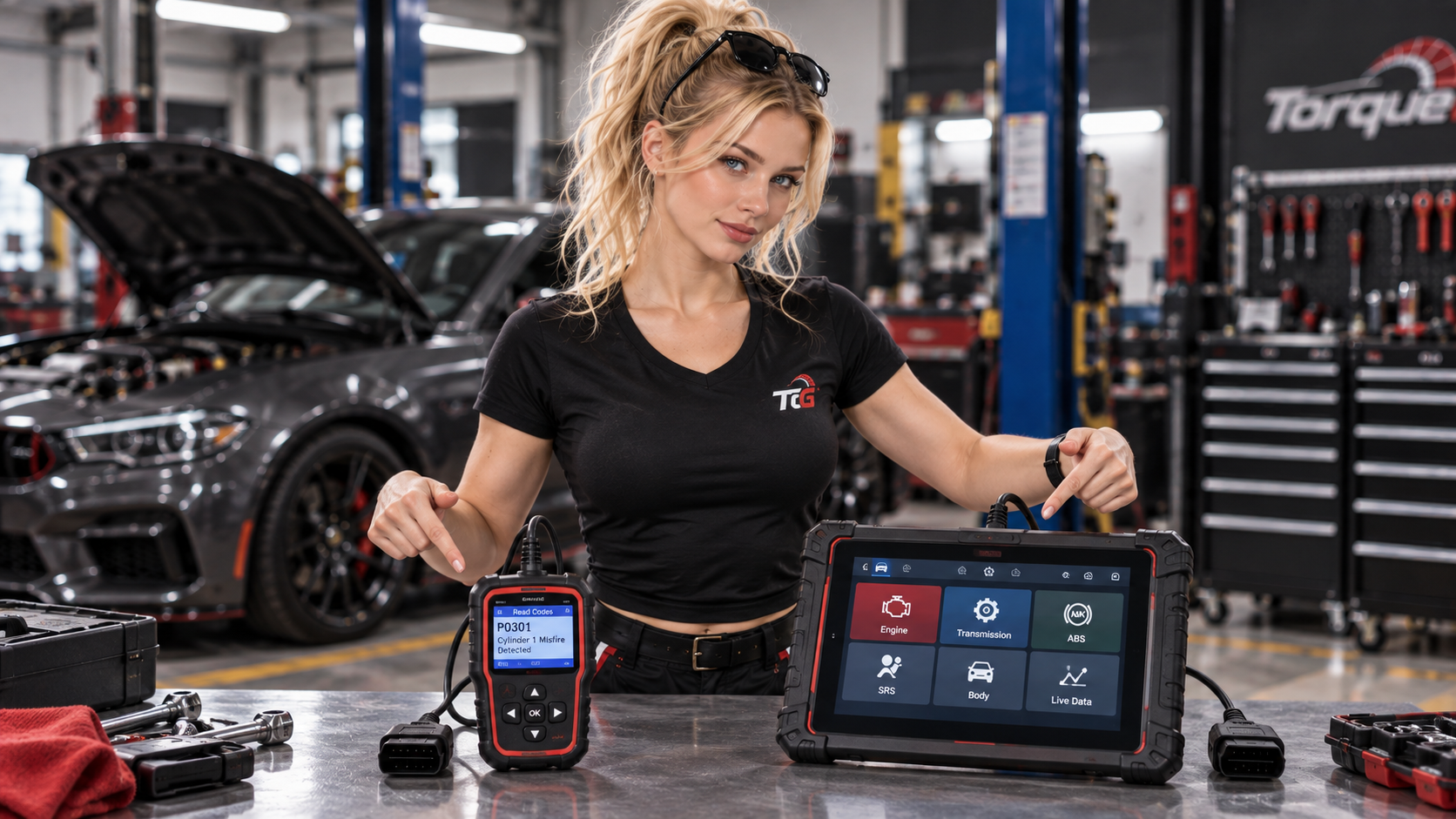
Code reader vs scan tool at a glance
| Capability | Basic code reader | Advanced scan tool |
|---|---|---|
| Generic engine DTCs | Usually | Usually |
| Clear codes | Usually | Usually |
| Basic live data | Sometimes | Usually |
| ABS | Limited / tool dependent | Often, vehicle dependent |
| SRS / airbag | Limited / tool dependent | Often, vehicle dependent |
| Transmission | Limited | Often |
| Enhanced manufacturer data | Limited | Often |
| Data graphing | Basic or none | Often |
| Service functions | Rare | Tool / vehicle dependent |
| Bidirectional controls | Rare | Available on some tools |
| Learning curve | Lower | Higher |
| Typical cost | Lower | Higher |
This is a capability pattern, not a guarantee. A specific reader may offer more or less, and an advanced tool still needs the right vehicle coverage to access a given system.
Why does the advanced tool cost more?
The price difference is not simply the size of the display. A large part of the product may be the software and vehicle coverage behind the hardware: broader databases, manufacturer-specific information, more communication protocols, more modules, service procedures, bidirectional communication, update infrastructure, and professional support.
That is why two tools with similar cables can behave very differently. The expensive part is often the ability to identify, interpret, and communicate with more of the vehicle—not just the ability to display a code.
What is live data?
A trouble code is a recorded observation. Live data lets you see what the vehicle is reporting now. Depending on the vehicle and tool, that may include RPM, coolant temperature, throttle position, fuel trims, sensor values, manifold pressure, and airflow.
Live data can help you form a better hypothesis. It still does not turn the scan tool into an automatic parts cannon. Readings need context: operating temperature, engine load, symptoms, service information, and a test plan.
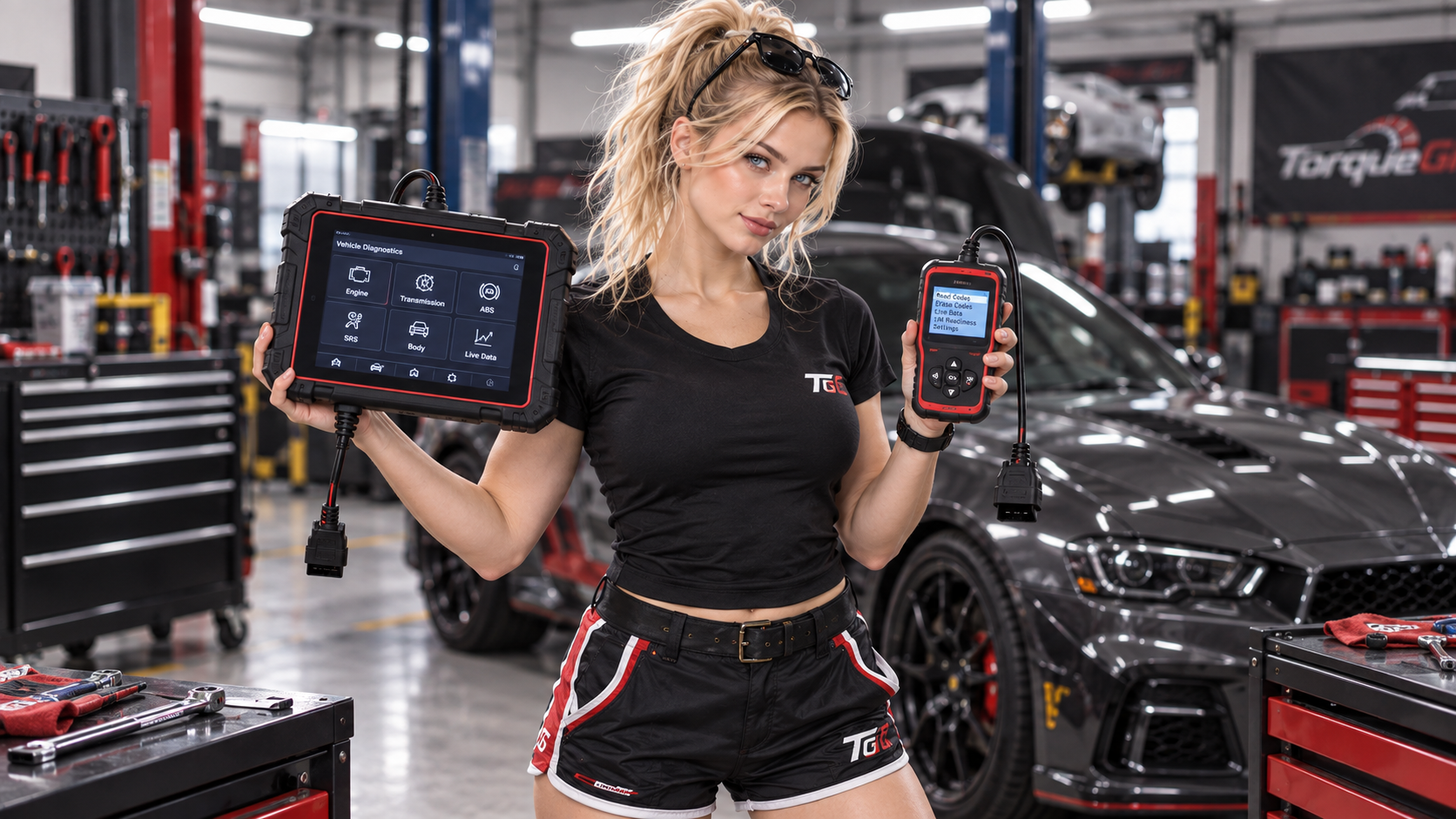
STFT means Short-Term Fuel Trim: the quick correction the engine controller is making to fueling. LTFT means Long-Term Fuel Trim: a learned correction that changes more gradually. These are useful clues, not standalone proof of a particular failed part.
If recorded data is your goal, check that your exact tool supports both logging and a usable text export, not only live display. Then read How to Analyze OBD2 Live Data and Logs to understand the evidence those features can provide.
Reading a code is not diagnosing the problem
Imagine a basic reader reports P0301 — Cylinder 1 Misfire Detected. You now know what the ECU detected. You do not yet know whether the cause is a spark plug, coil, injector, fuel delivery, wiring, compression, a vacuum or air issue, or another engine-management condition.
An advanced tool may provide more evidence through live data, enhanced codes, and additional module information. But even a professional tool does not eliminate the need to test. The TorqueGirl workflow remains:
The tool can improve the evidence. It cannot skip the reasoning.
When is a basic code reader enough?
A basic reader may be the right choice if you mainly want to investigate a check-engine light, own one vehicle, need generic engine and emissions codes, occasionally check readiness status, and prefer a simple tool. A modest tool that answers the question you actually have is not a bad tool.
When does an advanced scan tool make sense?
Consider the more capable category if you work on several vehicles, need ABS, SRS, or transmission diagnostics, want enhanced live-data analysis, perform service procedures, use the tool in a workshop, or need bidirectional testing where the vehicle and tool support it.
Those needs justify broader capability—but still require a coverage check. “Advanced” describes the tool’s potential, not a universal promise.
Where do Bluetooth adapters fit?
Bluetooth OBD2 adapters sit somewhere between a basic reader and a dedicated scan tool. The hardware may be simple, while much of the experience comes from the phone app: its definitions, live-data views, graphs, update policy, and supported vehicle functions.
They can be convenient and portable, but they depend on phone compatibility, app quality, wireless stability, and sometimes subscriptions. Evaluate the adapter and software as one system rather than assuming the small dongle tells the whole story.
Which one should a beginner buy?
Start with the questions you need to ask, not the most impressive tool you can find.
Choose a basic code reader if:
- Your main goal is check-engine-light diagnosis.
- You want simple generic OBD2 functions.
- You only need occasional code and readiness checks.
- Budget and simplicity matter most.
Consider an advanced scan tool if:
- You need more than engine and emissions diagnostics.
- You want enhanced live data or deeper module information.
- You work on several vehicles.
- You need ABS, SRS, transmission, service, or supported bidirectional functions.
Consider Bluetooth if:
- Portability matters.
- You prefer using a phone.
- You are comfortable checking app and vehicle compatibility.
Before you buy any OBD2 tool
- Check compatibility for your exact vehicle, model year, and market.
- Determine which systems you need to access.
- Check whether the live data you want is supported.
- Review manufacturer-specific coverage.
- Understand software and update costs.
- Check whether advanced functions require subscriptions.
- Do not assume “full system” means every function on every vehicle.
- Choose phone-based, handheld, or tablet-style operation based on how you will actually work.
OBD2 scanner vs code reader FAQ
Is an OBD2 scanner the same as a code reader?
Sometimes the terms are used interchangeably. In this article, a code reader means a simpler generic OBD2 tool, while an advanced scan tool can offer broader module access and deeper functions.
Can a cheap code reader diagnose a check-engine light?
It can often read generic engine and emissions codes, which is a useful first step. It may not access manufacturer-specific systems or provide enough data for deeper diagnosis.
Can a basic OBD2 reader diagnose ABS?
Usually not as a general rule. ABS access is tool- and vehicle-dependent, so confirm the exact coverage before buying.
Is an expensive scan tool more accurate?
More capable and more accurate are not identical concepts. A deeper tool can provide more evidence, but the quality of the diagnosis still depends on the vehicle data, test method, and interpretation.
Do I need bidirectional control?
Only if your diagnostic work requires commanding supported vehicle components or running active tests. It is an advanced function, not a requirement for reading a basic check-engine code.
Are Bluetooth OBD2 scanners good?
They can be useful when the adapter, app, and vehicle work well together. Their experience depends heavily on software, compatibility, wireless stability, and available data.
Can an OBD2 scanner tell me exactly which part is broken?
No. Diagnostic data provides evidence; diagnosis identifies the cause.
For the fundamentals of ports, DTCs, live data, and clearing a warning light, read What Is an OBD2 Scanner?. To understand what a code such as P0301 actually means, continue with How to Read OBD2 Codes. For more TorqueGirl engineering explanations, explore turbochargers and superchargers or Formula 1 downforce.